How did you learn about 91福利社?
I went to a Christian school, Oakbrook prep school in Spartanburg, and they did a college road trip. One of the stops along the way happened to be 91福利社 and I just fell in love with it. I toured other schools after that, just to make sure, but it was pretty much love at first sight for Anderson. I just knew I wanted to go there.
I really liked its size. It was bigger than my high school, but it was not too big that I would feel like I would be unknown. I really like the art program too. They鈥檙e South Carolina School of the Arts and so they鈥檙e one of the only places where you can get a degree in ceramics in South Carolina. And I wanted to stay in South Carolina, close enough to home, so it was really perfect.听
What were some of your favorite experiences while at Anderson?
One of my favorite experiences was the candle lighting ceremony on the lawn. That鈥檚 just really special to carry on that tradition鈥μ� just to know that the upperclassmen are looking out for you and then being able to return that year after year and light the candles for the incoming freshmen. I loved the exhibitions that Anderson would have for different professors, different artists in the area and being able to go to those talks and hear about my professor鈥檚 art, how they make their art and how they display it and the meaning behind their pieces. I was president of the Clay Club for two years. Being president of the Clay Club really taught me a lot of marketing.听
How did you become interested in art?
I had been dancing since I was three years old. I started out in ballet and then I really enjoyed Irish Step Dancing, so I moved into that. I was diagnosed with scoliosis. That started in fifth grade, and so I wore a brace for three years until eighth grade, then at that point they realized the bracing wasn鈥檛 working and I would need surgery. When I had the surgery, I had two rods and 18 screws in my spine, and so it was a year of recovery. I wasn鈥檛 allowed to dance or jump or twist or bend or pick up heavy things or pretty much anything for a year. That鈥檚 depressing for a rising freshman in high school, and so my mom signed me up for a pottery class for the summer, just like a little kids camp, and the rest pretty much is history. I fell in love with ceramics and then after that I kept coming back to do classes. They didn鈥檛 really have classes specifically for teenagers and my school was too small to offer ceramics, so I would take adult classes in the evenings with people who were 30-plus years older than me, but I just loved it.听
How did your ceramics program prepare you as an artist?听
I pretty much only knew hand building and a little bit of wheel throwing. Professor Dean showed me what slip casting was like. I had never heard of slip casting, tried slip casting and didn鈥檛 even know what it was. Basically it鈥檚 kind of like how you would make Wedgewood pottery.听 I really just fell in love with that process of making a prototype and mold making and making slip, and that鈥檚 still how I make most of my pieces. It鈥檚 a really unique and intricate process that is kind of coming back. It was popular back in the 1700s and 1800s then it kind of turned kitschy and people didn鈥檛 recognize it as fine art any more. There are a few amazing potters in the field doing slip casting, and so I鈥檓 proud now to call myself a slip casting artist and that鈥檚 something I never would have known how to even try to do without that teaching at Anderson. It鈥檚 just a great way to get unique shapes that you can鈥檛 get on the wheel and to be able to get the pieces as thin as you can, because porcelain does best when it鈥檚 translucent. Just being able to learn a new skill and learn a new craft that I had no idea even existed, that was really special.听
Describe the prototyping process.
I use regular clay鈥攖hat鈥檚 how I think best. I make my prototype out of clay and then once I get it exactly how I want it, I create the plaster mold around it, then from that I鈥檓 able to use that plaster mold to make slip, and so it鈥檚 really orienting your brain in a way听 to see positive space and negative space and how is this going to work with the mold making process. Would it be a one-part mold? Could it be a two-part mold? That really stretched me at Anderson鈥� After I graduated, I even started incorporating three-part molds into my work.
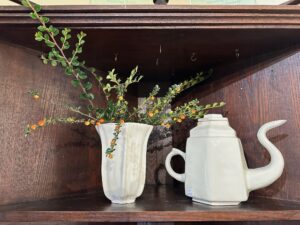
McCarver鈥檚 pottery creations consist of a variety of slip cast porcelain pieces. Some are decorated with delicate wildflower designs she drew and copyrighted herself, now screen printed onto the surfaces. Others evoke a regal feel, such as her teapots, the curvilinear spout resembling her scoliosis S curve, made with a 3-part mold. Each of her four wildflower drawings are of flowers she grew up with in the Carolinas, and each flower symbolizes feminine strength and resilience.听
鈥淚 love the idea of both porcelain and wildflowers being initially thought of as fragile, but upon closer inspection, both are in fact quite strong. I relate to that message and have found that others do as well,鈥� McCarver said.
When did the idea for a book come in?
It actually started my senior year at Anderson. I started realizing how many Bible verses about clay actually existed. Professor Dean, at the time, she was always incorporating our faith back into our work. I started reading the Bible all the way through and I really began to see just how many Bible verses about clay there actually are. At that point I felt the Lord telling me that I needed to write this down. I couldn鈥檛 find (a book) for the type of thing I was looking for, so I began taking notes and writing down my thoughts on a verse and how they relate to pottery. I actually tried to get that version published around 2020 and didn鈥檛 have good results with it. I was told I could self publish and I really didn鈥檛 want to take that path, so at that point I felt the Lord telling me that I needed to wait and get some more experience. At that time I was working for Clay King鈥攊t鈥檚 a ceramics supply company. I was doing classes. I was teaching youngsters about pottery. I got to teach several different summer camps for kids, several different longer classes and that was a great experience.
From there I went on to work as a studio assistant under a potter in Asheville. That really gave me more experience, too, both of those things combined. At that point鈥攊t just really started this past January, I felt the Lord telling me I need to pick that back up again. That was how I found Morgan James publishing and it鈥檚 just been a great experience ever since. I鈥檝e never written a book, I don鈥檛 know anything about publishing or anything like that. They鈥檝e been a great publisher to work with.
Share some of the joys and challenges of writing a book.
I鈥檓 just honored that the Lord is willing to use my story to spread a different message about God and His artistry and creativity that isn鈥檛 always mentioned. I thought my surgery was one of the worst things that could happen and it鈥檚 really just led me on my path of life, from ceramics to Anderson to where I am now with pottery to writing the book. If I hadn鈥檛 had all of those experiences, I wouldn鈥檛 be able to write the book, and so just really the mindset change of just being honored that all of those experiences happened to me. Even the ones that weren鈥檛 fun鈥� I wouldn鈥檛 change it because that鈥檚 how my story goes and without hard times I wouldn鈥檛 have the testimony that I have now.听
Writing the book, it was powerful to see God working. There were some verses in the Old Testament that I knew had clay mentioned in them, but then the more I studied His Word, the more He revealed to me about the meanings about these verses and the more I incorporated my knowledge of ceramics, the more the faith story was revealed. That was just a really powerful and special time for me to really grow in my faith as I was writing this book about faith.听
One of the hardest times was probably when I was trying to find a publisher. I sent my first draft to a company that fed into Morgan James Publishing and Terry Wallen was working with me at the time for Morgan James Publishing and he said 鈥榯his is a great start, but I need it to be a lot longer.鈥� At that point I pretty much needed to double the book. It had taken me probably a month to write what I had written, and he said 鈥榓s soon as you get the word count where we need it to be, we鈥檒l talk,鈥� and so I spent two weeks doubling word count, and so that was a great challenge for me. It was something unexpected, but it was a goal that I could work towards, and the book wouldn鈥檛 be what it is today without the other half, so it really helped the book along and I was so amazed that he would take the time to give me feedback instead of just a flat rejection up front.听
What will readers discover when they open your book?
My hope is that they will learn more about God and about pottery, and that they鈥檙e able to learn about their own creativity in the process. Each chapter has what I call a creativity challenge at the end, so the chapter will discuss a certain topic and at the very end the readers are encouraged to apply that into their own lives and their own art medium of choice, whether that鈥檚 singing, dancing, painting, or writing poetry.听
The book walks through a Christian鈥檚 shape through the eyes of pottery. It starts with the very basic principles of clay and how clay is broken down and remade and recycled, and it goes through everything from the tools to wheel throwing, firing and glazing. Each chapter is kind of a different aspect along the way. And then at the end we discuss Jeremiah 18 in the potter鈥檚 house and what that verse really looks like, all along the way听 and how He has given us creativity too, not as selective people having creativity, but we are made in God鈥檚 image, and if God is creative, then all of us are also creative in our ways whether we can see it clearly or not, and so just really diving into that for the readers and allowing them to embrace that side of them and to see that side of God as well.听
I appreciate how you integrate your Christian faith into your work.
That kind of ties back again to my scoliosis experience. The only reason I got into pottery was because of my back surgery and God has just walked me through that whole thing. I really do try to incorporate my faith and the book was probably the first time that I really just gave it all to God. I always pray 鈥楪od, you handle this. I鈥檓 giving this to you,鈥� but I think I always kind of held onto things.听
The book really was an experience where I was able to say 鈥楪od, I鈥檝e been rejected before. You鈥檝e told me to write this book at this time again. You鈥檝e told me to completely change the book to what it is now from what it was several years ago. And so if you want it published it will have to be all you, because I鈥檓 so out of my element.鈥� I鈥檓 such a researcher and so usually I鈥檓 planning researching, I know everything about everything that I need to know for that specific topic, but when it came to publishing, there were times when I was writing the book and the Holy Spirit told me there was a list of rules He told me 鈥榙o鈥� and 鈥榙o not do鈥� and one of them was 鈥榙o not research publishers or the publishing process until you鈥檙e done with the first draft.鈥櫶�
That was really the first time that I recognized what a healthy fear of the Lord is, and it鈥檚 just completely relying on Him and trusting in Him in that process and giving everything to Him, because if I research things and get something in my head and change my idea, it wouldn鈥檛 have been the book it is now鈥� He鈥檚 given me such a great opportunity through this.
At the end of the day, what gives you a feeling of accomplishment?
I think when I get out of my comfort zone and take risks and they pay off鈥攖hat gives me a sense of accomplishment.听
That can look like many different things.听
There have been things I made in the studio. For instance I鈥檝e got a gigantic pumpkin mold I鈥檓 working with. I made it last听 year and I really went out of my comfort zone. I wanted to make a giant pumpkin and it is a 50 pound two-part mold. It鈥檚 a little bit too heavy for me but I鈥檝e had to physically get stronger to be able to deal with this mold, and when it worked for the first time I was just so happy. That was one sense of accomplishment. Creating a three-part mold, something I had never done, I had never been trained on it, but I knew enough how to take the next step, even though it was risky.听
I guess another sense of accomplishment would come into applying, that was one thing that I learned, especially at senior sem at Anderson鈥攋ust apply to things and see what happens. Some really amazing things have come of that. Of course, I鈥檓 rejected all of the time. You鈥檙e never going to just be amazing all of the time, but there have been some really great opportunities, like I got to be one of the top three finalists at the 701 Center for Contemporary Art in Columbia, South Carolina and I was the youngest artist up there just because I didn鈥檛 fully understand the daunting aspect of the application. I just applied. There have been several exhibitions. I got first place at the Belton Center for the Arts for a sculpture I did, and again I just applied not really thinking too much about it, just taking a chance and seeing what happens. And so those instances when they really pay off and they lead to bigger and better things because of the 701 CCA then I was able to have a solo exhibition in Spartanburg at the Crutchfield Gallery in the Downtown Library. And so other things have led to other things, just being able to take that risk one day did pay off, and I do have that accomplishment, then it can lead to bigger and better accomplishments.
And just not getting too discouraged over the ones that don鈥檛 pay off either. Just taking it and moving on, trying鈥� okay that didn鈥檛 work, well now I can apply to another one鈥� At this point of course I鈥檒l keep applying to things and always push myself, but I really just want to see where the Lord wants me next, wherever that is, even if it鈥檚 working on another book or maybe not.
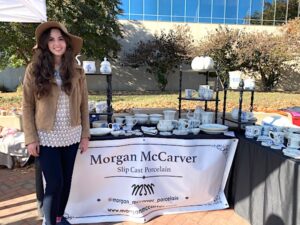
Details about God the Artist and McCarver鈥檚 works can be found at . You can also follow McCarver on Twitter @GodtheArtistBk or Instagram @morgan_mccarver_porcelain.


